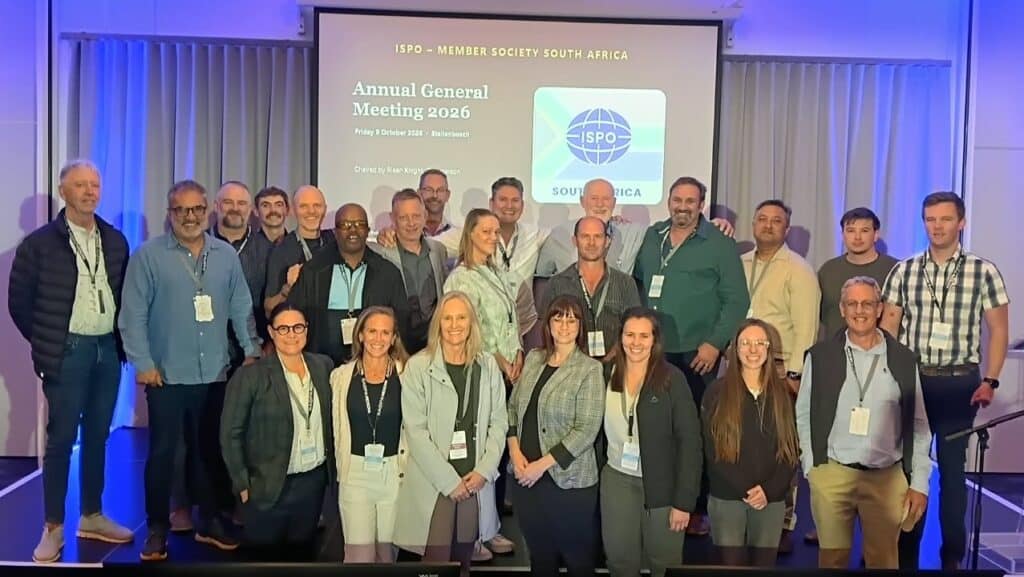
ISPO South Africa celebrates International Prosthetics and Orthotics Day 2026 – “People”
This year South Africa’s orthotic and prosthetic community celebrated a milestone many of us never thought we would see. Dr Mariëtte Deist, Programme Coordinator of Medical Orthotics and Prosthetics at Tshwane University of Technology (TUT), became the first person to be awarded a doctorate in Medical Orthotics and Prosthetics by TUT. Her achievement is a huge milestone, and a worthy chapter in building the Prosthetic and Orthotic occupation in South Africa.
Fittingly, Dr Deist and her colleagues Chanelle Ribeiro-Wagener and Prof Terry Ellapen (A Biokineticist of profession) also wrote the first peer-reviewed history of our profession in South Africa, published in Prosthetics and Orthotics International in 2025. It reminds us of where we come from, and Mariëtte’s Doctorate achievement tells us where we are at.

The limb makers
In 1942 the Johannesburg Limb Factory trained its first four students: P. Marais, J. Pentz, F.A. Kleinhans and T. Tremeer, later joined by E.A. Louw and E. Teich. Each spent a year in England learning the latest O&P techniques. In 1947 Artificial Limb Centres opened at Auckland Park in Johannesburg and at Frere Hospital in East London, offering four years of in-service training mentored by doctors and nurses. A year later, heads were appointed in all four provinces.
From workshop to university
Training was standardised in 1978, and in 1985 the then Technikon Pretoria, now TUT, offered South Africa’s first diploma in Medical Orthotics and Prosthetics. For close to three decades it was the country’s only training institution. In 2002 a Bachelor of Technology degree, developed by Prof E. Genis and Prof J.J. Pieterse, allowed South Africa to train ISPO Category I practitioners. TUT introduced its four-year Bachelor of Health Sciences in 2020, gained approval for postgraduate programmes in 2022, registered its first doctoral student in 2023 and received ISPO accreditation that December.
With the SA Government approval other O&P training centers have since joined our journey. Durban University of Technology began its degree in 2013 and opened its academic department at Wentworth Hospital in 2014. Walter Sisulu University followed in 2014 and established its department with a first intake of 30 students. Together, the three universities can now prepare close to 100 new practitioners a year, and the number of registered practitioners grew from 466 in 2014 to 786 in 2023. In the early 1980s, only a certificate course was available. At PE Provincial Hospital, other health professionals called us “technicians” – if we were lucky, “orthopaedic technicians”. To see one of our own hold a doctorate some 40 years later is deeply moving.
I AM P&O
For ISPO South Africa, “I AM P&O” means every person in this story, the first limb makers who learnt their craft abroad, the technicians and clinicians who carried the profession through difficult years, the lecturers who built degrees from nothing, the students in our classrooms today and, above all, the people who walk, work and live fuller lives because of what we as P&O do.
From limb makers to doctors, people have always been our strength. We congratulate Dr Deist, thank TUT, DUT and WSU, and look forward to the next generation of South African researchers.
Riaan Knight
Chairperson, ISPO South Africa (National Member Society)
chairperson@isposa.co.za | www.isposa.co.za
Reference: Deist M, Ribeiro-Wagener C, Ellapen TJ. The development of the profession and education of Prosthetics and Orthotics in South Africa. Prosthetics and Orthotics International, 2025. DOI: 10.1097/PXR.0000000000000434