
English
The journey of Marie-Ève Croteau is one of an athlete who has transformed every challenge in her life into an opportunity for growth and achievement. An iconic figure in Canadian para-cycling, she faced significant obstacles long before representing Canada on the international stage. As a teenager, she was seriously injured after being struck by a vehicle, leaving her with permanent impairments to her left upper limb. Several years later, myelitis caused paralysis in her legs, and physicians told her she might never walk again. Through intensive rehabilitation and extraordinary determination, she gradually regained her mobility and discovered para-cycling, a sport that would change her life.
In less than two years, Marie-Ève Croteau went from being a rehabilitation patient to becoming a high-performance athlete. She achieved success on the international stage, won world titles, and competed at the Rio 2016 Paralympic Games and the Tokyo 2020 Paralympic Games, establishing herself among the world’s top para-cyclists.
In 2024, her resilience was tested once again. Following a severe flesh-eating bacterial infection, she underwent a foot amputation. For many, such an event might have marked the end of an active athletic life. Instead, she saw it as the beginning of a new chapter. Her guiding principles, never give up and always stay positive, became the foundation upon which she rebuilt her life and rediscovered her passion for sport.
After another period of adaptation and rehabilitation, she gradually regained her independence and resumed her activities with the same determination that has defined her journey.
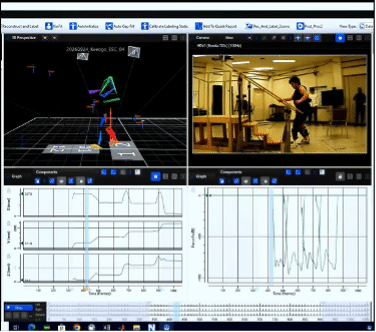
For the past several months, supported by her clinical team, she has been participating in the evaluation of the Keeogo exoskeleton, developed by the Quebec-based company B-Temia. This wearable assistive technology has enabled her to significantly increase her level of physical activity, reduce the limitations associated with her impairments, and push beyond her perceived limits in everyday life. As part of this initiative, her progress is being documented at the Motion Analysis Laboratory of the Centre for interdisciplinary research in rehabilitation and social integration (Cirris), where comprehensive laboratory assessments are used to objectively measure the effects of the exoskeleton on her mobility, gait biomechanics, and functional capacity. The benefits observed have translated into greater participation in daily activities, recreation, and sports.
More recently, Marie-Ève Croteau accomplished a goal that would have seemed out of reach only months earlier by completing the Défi des couleurs du Mont-Sainte-Anne, covering 6.5 km of forest trails. She has also returned to playing hockey, continuing her journey toward an active and fulfilling lifestyle.
Her story powerfully illustrates the combined impact of rehabilitation, technological innovation, and unwavering determination. More than a Paralympic athlete, Marie-Ève Croteau has become a symbol of resilience, demonstrating that limits can be redefined when courage meets the right solutions.
Written by Katia Turcot, PhD
Full Professor, Department of Kinesiology, Université Laval
Researcher, Centre interdisciplinaire de recherche en réadaptation et intégration sociale (Cirris), Santé Québec Capitale-Nationale – Universitaire
Board Member, ISPO Canada


FRANÇAIS
Le parcours de Marie-Ève Croteau est celui d’une athlète qui a transformé chacune des épreuves de sa vie en moteur de dépassement. Figure emblématique du paracyclisme canadien, elle a connu un chemin semé d’obstacles bien avant de représenter le Canada sur la scène internationale. À l’adolescence, elle est gravement blessée après avoir été happée par une voiture, conservant des séquelles permanentes au membre supérieur gauche. Quelques années plus tard, une myélite provoque une paralysie de ses jambes et les médecins lui annoncent qu’elle pourrait ne plus jamais marcher. Grâce à une réadaptation intensive et à une détermination hors du commun, elle retrouve progressivement sa mobilité et découvre le paracyclisme, une discipline qui changera sa vie.
En moins de deux ans, Marie-Ève passe du statut de patiente en réadaptation à celui d’athlète de haut niveau. Elle accumule les performances internationales, remporte des titres mondiaux et participe aux Jeux paralympiques de Rio 2016 ainsi qu’aux Jeux paralympiques de Tokyo 2020, s’imposant parmi les meilleures paracyclistes au monde.
En 2024, une nouvelle épreuve met sa résilience à rude épreuve. Victime d’une bactérie mangeuse de chair, elle doit subir l’amputation de son pied gauche. Pour plusieurs, un tel événement aurait marqué la fin d’une vie sportive active. Pour elle, il s’agit plutôt du début d’un nouveau chapitre, car ne jamais abandonner et rester positive sont ses 2 philosophies de vie qui seront essentielles pour se rebâtir. Au terme d’une nouvelle période d’adaptation et de réadaptation, elle retrouve graduellement son autonomie et reprend ses activités avec la même détermination qui a toujours caractérisé son parcours.
Depuis plusieurs mois, accompagnée de son équipe clinique, elle participe à l’évaluation de l’exosquelette Keeogo, développé par la société québécoise B-Temia. Cette technologie d’assistance à la marche lui permet d’accroître considérablement son niveau d’activité, de réduire les limitations associées à ses déficiences et de repousser ses propres limites au quotidien. Dans le cadre de ce projet, son évolution est documentée au laboratoire d’analyse du mouvement du Centre interdisciplinaire de recherche en réadaptation et intégration sociale (Cirris), où des évaluations en laboratoire permettent d’objectiver les effets de l’exosquelette sur sa mobilité, sa biomécanique de marche et sa capacité fonctionnelle. Les bénéfices observés se traduisent concrètement par une participation accrue aux activités de la vie courante, aux loisirs et à la pratique sportive.
Plus récemment, Marie-Ève Croteau a relevé un défi qui semblait encore inaccessible quelques mois auparavant en complétant le Défi des couleurs du Mont-Sainte-Anne, parcourant 6,5 kilomètres en sentier. Elle pratique également le hockey, poursuivant son retour à une vie active et engagée.
Son histoire illustre avec force l’impact combiné de la réadaptation, de l’innovation technologique et d’une volonté exceptionnelle. Plus qu’une athlète paralympique, Marie-Ève Croteau est aujourd’hui un symbole de résilience, démontrant que les limites peuvent être redéfinies lorsque le courage rencontre les bonnes solutions.
Écrit par Katia Turcot, PhD
Professeure titulaire, Département de kinésiologie, Université Laval
Chercheure, Centre interdisciplinaire de recherche en réadaptation et intégration sociale (Cirris), Santé Québec Capitale-Nationale – Universitaire
Membre de conseil d’administration ISPO Canada